Call for Papers
Workshop on AI Accelerating Sustainable Development Goals (AI4SDG)
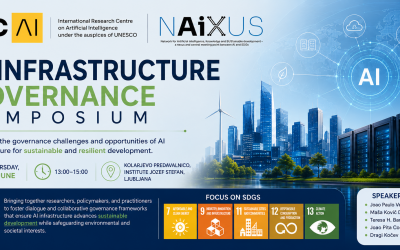
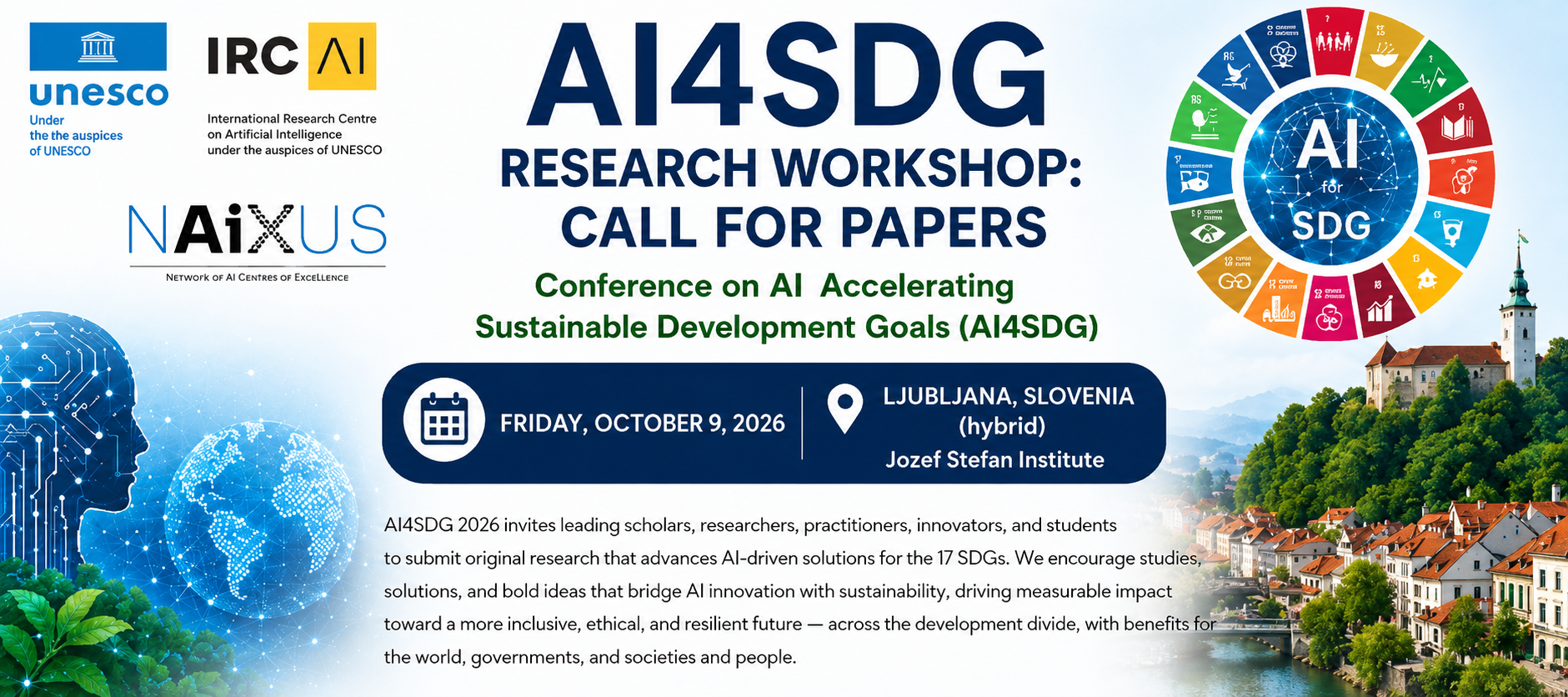
The International Research Centre on Artificial Intelligence under the auspices of UNESCO (IRCAI), the Center for Artificial Intelligence and Machine Learning at the University of Sao Paulo (CIAAM), and the Network for Artificial Intelligence, Knowledge and SUStainable development (NAIXUS) invite researchers, PhD candidates, practitioners, policymakers, innovators, and interdisciplinary scholars to submit original contributions for the AI4SDG Workshop on Friday, October 9, 2026 at IRCAI’s headquarters, in the Jozef Stefan Institute in Ljubljana, Slovenia (hybrid).
Artificial Intelligence is rapidly reshaping societies, economies, governance systems, education, healthcare, environmental monitoring, and industrial processes. As the global community advances toward achieving the United Nations Sustainable Development Goals (SDGs), AI technologies present transformative opportunities to accelerate sustainable development while also introducing new ethical, governance, and societal challenges. This special collection aims to explore how AI can support inclusive, ethical, human-centered, and sustainable development across sectors and regions. The collection seeks interdisciplinary research addressing both technological innovation and societal impact, emphasizing practical applications, governance frameworks, policy implications, and responsible deployment of AI for sustainability. We welcome theoretical, empirical, technical, policy-oriented, and case-study contributions that examine how AI systems can support sustainable futures aligned with the SDGs. Selected best papers will be published on a Special Collection at the Journal of Artificial Intelligence for Sustainable Development (JAISD) later in the year.
Aims & Objectives
The objectives of this special collection are to:
- Promote cutting-edge scientific and technological research contributing to sustainable development
- Disseminate advanced knowledge and AI expertise across regions, disciplines, and communities
- Develop synergies and cross-fertilization between academia, industry, policymakers, and investors
- Encourage collaborative research ecosystems and international networks of excellenc
- Support the creation of virtual and distributed research infrastructures for AI and SDGs
- Advance data-driven benchmarking, monitoring, and impact assessment frameworks for SDGs
- Foster AI solutions that contribute to resilient, inclusive, and sustainable societies
- Strengthen educational initiatives and capacity-building activities related to AI and sustainability
- Encourage practical and deployable AI systems with measurable societal impact
- Create opportunities for interdisciplinary dialogue on governance, ethics, regulation, and responsible innovation
Topics of Interest
Topics include, but are not limited to:
1. GenAI and Agentic AI for open education, OERs and lifelong learning
2. AI for climate change resilience, disaster risk reduction and environmental sustainability
3. Human-centric and trustworthy AI for smart and sustainable cities, AI-enabled digital twins and ethical
4. Sustainable AI infrastructures, AI orchestration and privacy-preserving AI for energy efficiency and green transitions
5. Federated learning, citizen science and causal inference and discovery for SDG indicators
6. Ethical, legal, and societal implications of AI in Citizen Science
7. Explainable, transparent, and accountable AI governance, regulation, and policy frameworks
8. Digital inclusion with AI for democracy and public participation
9. Multi-agent systems and collaborative AI for humanitarian action and crisis response
10. Frugal AI, Edge AI and TinyML for SDGs
Organising Committee
Joao Pita Costa, IRCAI, Jozef Stefan Institute, Slovenia
John Shawe-Taylor, IRCAI & UNESCO AI Chair on AI at University College London,UK
Dunja Mladenić, Department for AI & IRCAI, Jozef Stefan Institute, Slovenia
Marco Zennaro, UNESCO ICTP, Italy
Joao Paulo Veiga Candia,Center of AI and ML at the University of Sao Paulo, Brazil
Mitja Jermol, IRCAI & UNESCO Chair on OER, Jozef Stefan Institute, Slovenia
Scientific Committee
Cristina Godoy, Center of AI and ML at the University of Sao Paulo, Brazil
Neena Goveas, Birla Institute of Technology & Science, Pilani, Goa India
Marko Grobelnik, IRCAI & OECD AI, Jozef Stefan Institute, Slovenia
Mitja Jermol, IRCAI & UNESCO Chair on OER, Jozef Stefan Institute, Slovenia
Chalitda Madhyamapurush, ETDA, Thailand
Matjaž Mikoš, UNESCO Chair on Disaster risk reduction, University of Ljubljana, Slovenia
Dunja Mladenić, Department for AI & IRCAI, Jozef Stefan Institute, Slovenia
Joao Pita Costa, IRCAI, Jozef Stefan Institute, Slovenia
John Shawe-Taylor, IRCAI & UNESCO AI Chair on AI at University College London,UK
Andrej Srakar, IRCAI & School of Economics and Business of the University of Ljubljana, Slovenia
Joao Paulo Veiga Candia, Center of AI and ML at the University of Sao Paulo, Brazil
Marco Zennaro, UNESCO ICTP, Italy
Important Dates
Call open: 5 June 2026
Abstract submission deadline: 15 30 July 2026 (extended)
Full paper submission deadline: 15 August 2026
Peer review notification: 15 September 2026
Conference registration: 15 September 2026
Workshop attendance: 11 October 2026
Submission Guidelines
Authors are invited to submit original and unpublished manuscripts that are not currently under review elsewhere. Submissions may include:
Original research articles
Review papers
Technical papers
Case studies
Policy and governance analyses
Interdisciplinary perspectives
The call for abstracts will be open from May 30th to June 30tht 2026. Abstracts (300–500 words) should clearly outline the research focus and relevance to the journal’s scope/pillar, methodology, and interdisciplinary contribution, as well as anticipated findings or implications. A rolling review process will begin during the final weeks of the call. This will allow early submissions to receive feedback promptly. All abstract reviews will be completed within one month of the call’s closing. Selected authors will receive invitations to submit full papers to the JAISD ordinary edition August 15th to submit 4-page manuscripts (including references).
The workshop is hybrid, colocated with the 29th International Multiconference IS2026 in Ljubljana, Slovenia, an excellent opportunity to visit IRCAI. Accepted papers follow the Multiconference registration and have access to the week long event with an special inaugural fee of 100 EUR.
All submitted manuscripts will undergo peer review. Once authors received their peer reviews, they will have a maximum of 2 weeks to send their final version. The accepted conference papers will be published on September 15, 2026.Submissions: Manuscripts should follow the IEEE author guidelines and formatting requirements.
Please submit abstracts and 4 page manuscripts (including abstract and references) over easychair or via email to: joao.pitacosta@ircai.org and indicate in the subject line: “NAIXUS AI4SDG Workshop 2026”