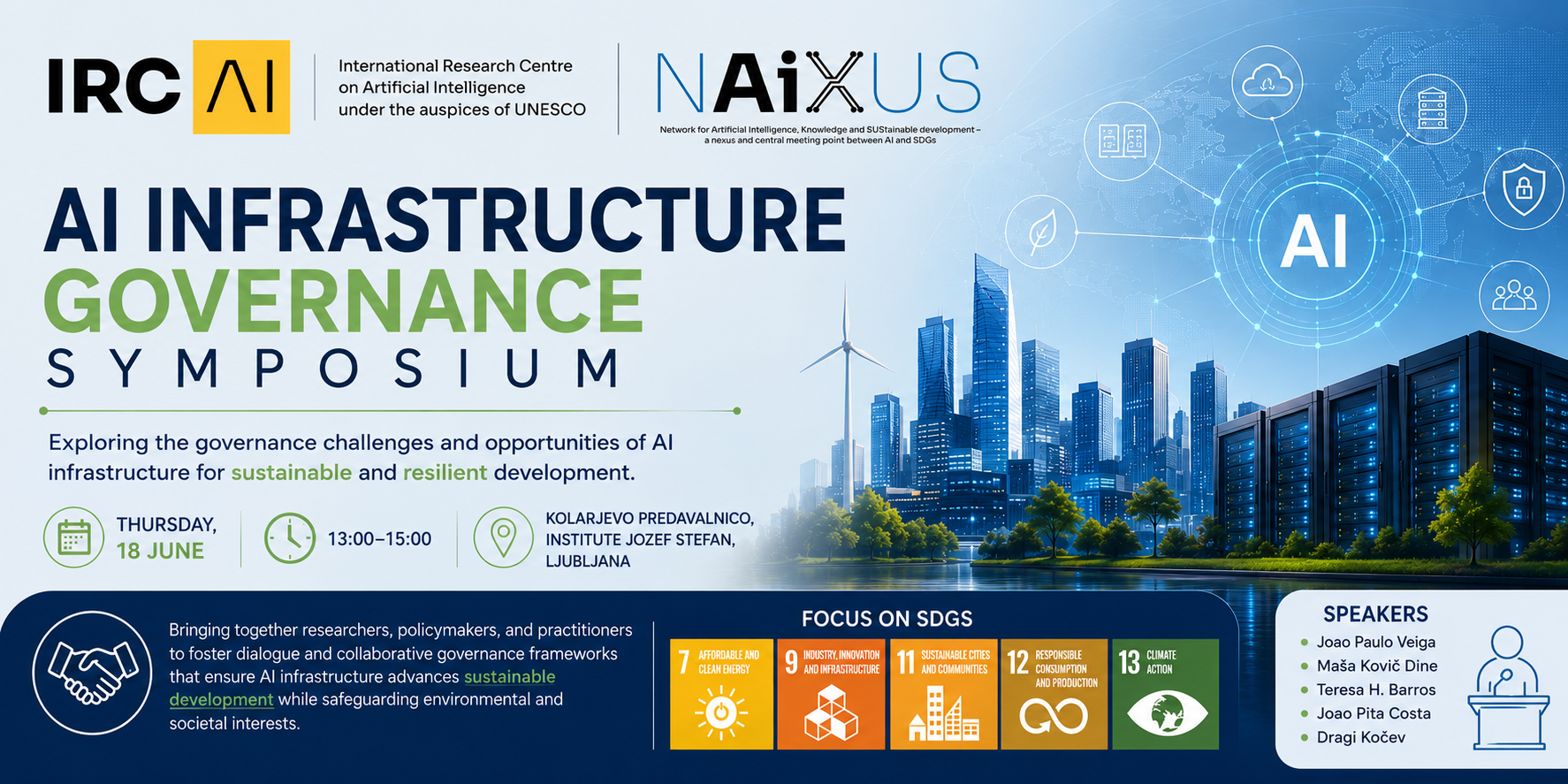
Thursday, 18 June | 13:00–15:00
Kolarjevo predavalnico, Institute Jozef Stefan, Ljubljana
The AI Infrastructure Governance Symposium, organized by IRCAI, brings together researchers, policymakers, and practitioners to explore the governance challenges emerging from the rapid expansion of artificial intelligence infrastructure and its implications for sustainable development.
The symposium will present results from a new European Union–Latin America and Caribbean (EU–LAC) collaboration focused on aligning artificial intelligence, high-performance computing (HPC), data centres, and digital infrastructure with the Sustainable Development Goals (SDGs). A key outcome of this collaboration is the development of advanced AI-enabled visualizations that analyse the impact of AI and data-centre infrastructure on SDG 9 (Industry, Innovation and Infrastructure). These tools integrate technical indicators, policy intelligence, scientific evidence, and media tracking to identify environmental, regulatory, geopolitical, and cybersecurity risks associated with AI infrastructure expansion. The initiative contributes to the development of internationally interoperable governance standards and best practices supporting sustainable, resilient, and sovereign AI ecosystems aligned with SDGs 7, 9, 12, and 13.
The symposium will also examine the growing relationship between AI infrastructure and urban development through the lens of SDG 11 (Sustainable Cities and Communities). As hyperscale AI data centres increasingly shape energy systems, environmental sustainability, and urban planning, cities face new governance challenges comparable to the historical influence of ports on industrial development. Drawing on international examples and emerging initiatives, the discussion will introduce the concept of the AI infrastructure–city relationship and explore how responsible AI governance can support digital sovereignty, human rights, social inclusion, environmental responsibility, and urban resilience.
The agenda is as follows:
13:00 Irena Gril (Ministry of Foreign Affairs, Slovenia) – Opening speech
13:05 Monika Krope (IRCAI, Institute Jozef Stefan, Slovenia) – EU-LAC Digital Alliance
13:10 Joao Paulo Veiga (CIAAM/USP, Brazil) – Guest Keynote: On EU–LAC Collaboration on Infrastructure, Capacity, and AI for the SDGs Toward Environmentally Sustainable and Sovereign AI
13:40 Maša Kovič Dine (ULjublajan, Slovenia) – Host Keynote: Responsible AI Governance for Human Rights–Aligned Urban Sustainability and the Governance Challenges of SDG 11
14:10 Teresa H. Barros (CIAAM/USP, Brazil) – Guest Talk: Data centres and AI Infrastructure in Brazil: challenges and opportunities
14:25 Dragi Kočev (SLAIF, Institute Jozef Stefan, Slovenia) – Host Talk: AI factories: Empowering AI capacity in Europe and
14:30 Joao Pita Costa (IRCAI, Institute Jozef Stefan, Slovenia) – Host Talk: ELIAS European Lighthouse of AI for Sustainability
14:45 Closure
The event aims to foster dialogue on how governments, industry, academia, and international organizations can collaboratively design governance frameworks that ensure AI infrastructure development advances sustainable development while safeguarding environmental and societal interests.
Access over the following zoom link: https://zoom.us/j/96508314177?pwd=0xEsEcE6XV2RaDsOUXcRTM333o2OUv.1 and contact joao.pitacosta@ircai.org for any further clarification.