
AI4SDG 2026 WORKSHOP
Artificial Intelligence Accelerating Sustainable Development Goals (AI4SDG)
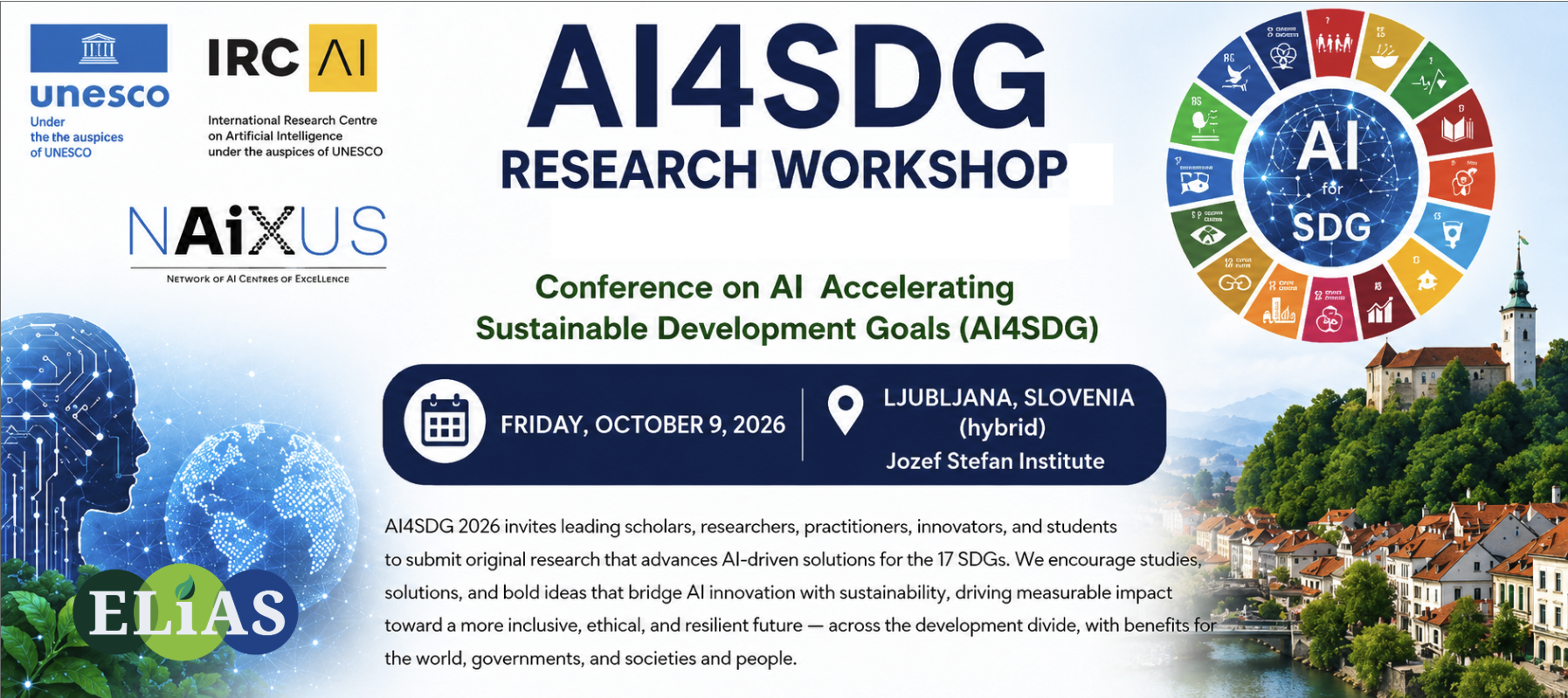
Date: 9th of October 2026 Location: Jozef Stefan Institute, Ljubljana,Sovenia
This workshop is colocated with the 29th International Multiconference IS2026 held on October 5-9 2026 in Ljubljana, Slovenia. It is hosted at the Jozef Stefan Institute, organized by IRCAI in cooperation with ICAIRE and CIAAM at the University of Sao Paulo (Brazil), supported by the NAIXUS excellence Network for Artificial Intelligence, Knowledge and SUStainable development, and by ELIAS the European Lighthouse of AI for Sustainability.
The “AI Accelerating Sustainable Development Goals (AI4SDG)” workshop, hosted by Naixus, aims to harness Artificial Intelligence (AI) for advancing Sustainable Development Goals (SDGs) with a focus on how AI can support inclusive, ethical, human-centered, and sustainable development across sectors and regions. The workshop seeks the needed discussion of experts and innovators on interdisciplinary research addressing both technological innovation and societal impact, emphasizing practical applications, governance frameworks, policy implications, and responsible deployment of AI for sustainability. This event features a Half-Day Hybrid Workshop, from 9AM to 12PM CEST followed by an online event from 2PM to 4PM CEST. Following the success of past events, such as the AI in Africa & SDGs workshop in Malmo in 2024, it is designed to stimulate discussion, encourage collaboration, and showcase AI solutions, the workshop seeks to connect researchers, practitioners, policymakers, and communities worldwide.
By showcasing impactful AI initiatives and facilitating the exchange of knowledge and experiences, this initiative aims to strengthen collaboration between AI and SDG communities worldwide. It seeks to identify practical approaches for applying AI to climate action and to support progress towards the Sustainable Development Goals through innovative technological solutions. Bringing together participants from diverse backgrounds, the workshop provides a platform for advancing sustainable development by exploring how AI can contribute to addressing global environmental and societal challenges.
If you not here with us please connect at https://zoom.us/meeting/register/LUOvSxdDRVGpSl1eXIkRdg
THE AI4SDG AGENDA
| Time | Activity | Details | |
| 09:00 – 09:05 | Welcome | Opening Remarks | Joao Pita Costa & John Shawe-Taylor, IRCAI, Slovenia |
| PART 2 | Chair: | Joao Pita Costa, IRCAI | John Shawe-Taylor, IRCAI, Slovenia |
| 09:05 – 09:20 | Keynote | Mapping Artificial Intelligence Research for Climate Change Resilience, Disaster Risk Reduction, and Environmental Sustainability: A Bibliometric Perspective on Accelerating the SDGs | Krishnashree Achuthan, Amrita Vishwa Vidyapeetham, India |
| 09:20 – 09:30 | Ceremony | MoU Signing Ceremony between IRCAI & Amrita Science Institute | |
| 09:30 – 09:40 | Paper Presentation | Revisiting Sustainability by Design in AI Protocol Governance: An Empirical Review of Comparative DAO and Corporate-Led Standards for the SDGs | Luyao Zhang, Duke Kunshan University, China |
| 09:40 – 09:55 | Paper Presentation | ClimateRAG: AI-Assisted Comparative Analysis of National Climate Commitments and Open Corpus | Innocent Nyalala, IIT Madras Zanzibar, Tanzania |
| 09:55 – 10:10 | Paper Presentation | The Emerging AI Power Crisis or Collusion of Two Revolutions | Imen Ghedhioui, UN University, Portugal |
| 10:10 – 10:20 | Paper Presentation | Documented, Not Governed: Public Algorithm Registers and the Runtime Gap in EU AI Act Deployer Obligations | Hristijan Jankulovski, QX, Florence, Italy |
| 10:20 – 10:30 | Paper Presentation | AI-Enabled Knowledge Infrastructures for Social Innovation: Business Value, Adoption, and Governance | Syed Muhammad Ali Abbas, Matjaž Gams, JSI Intelligent Systems, Slovenia |
| 10:30 – 10:40 | Coffee Break |
|
|
| PART 2 | Chair: | Anja Polajner, IRCAI |
|
| 10:45 – 11:00 | Keynote | AIDE: Leadership in AI Literacy for Inclusive SDG-Aligned Learning in Marginalized Educational Communities | Mohammad Rizal Mohd Yusuf, Julieyana Jaris, Ministry of Education, Malasya |
| 11:00 – 11:10 | Paper Presentation | Responsible AI Implementation in Education: Protecting children’s rights in educational chatbot interactions with younger learners | Bernice Yeo, Ministry of Education, Singapore |
| 11:10 – 11:20 | Paper Presentation | Governing AI in Primary Education: A Process-Aware Policy Framework | Thierry Geoffre, University of Luxembourg & Edulwise, Luxembourg |
| 11:20 – 11:30 | Paper Presentation | Artificial Intelligence in Inclusive Classrooms: Exploring Teachers’ Perceptions, Challenges, Opportunities and Professional Development Needs for Children with Disabilities | Sneh Bansal,Exceed college , UAE & Hub coordinator, OE4BW |
| 11:20 – 11:30 | Paper Presentation | Decolonising the Digital Classroom: A Theoretical Case for AI-Mediated Indigenous Knowledge Integration in Open Distance eLearning | Terungwa James Age, Univ. of South Africa, SA |
| 11:30 – 11:40 | Paper Presentation | Artificial Intelligence Readiness in Brazilian Schools: A Nationwide Survey of Teachers and Educational Challenges | Bruno Rafael Florentino, University of São Paulo; Camila Sestito, Instituto Significare, Federal Technological University of Paraná, Brazil |
| 12:00-14:00 | Break | JSI Confrence closing Ceremony (12:00-13:00) | |
| 14:00 – 14:05 | Welcome | Opening of the Online Session | |
| PART 3 | Chair: | Israa Aljarb, ICAIRE | |
| 14:05 – 14:20 | Keynote | Research Highlights at UNESCO’s Global Forum on the Ethics of AI | Israa Aljarb, ICAIRE, Saudi Arabia |
| 14:20 – 14:30 | Paper Presentation | Rethinking the ‘Good’ in AI for Good: Communities as Judges of University-Led AI for Sustainable Development | Leila Cellerier, University of Geneva, Switzerland |
| 14:30 – 14:40 | Paper Presentation | Beyond AI Governance: Digital Space Resilience and the Bad Actor Problem | Francesca Bosco, Centre for a Positive Digital Future, Geneva, Switzerland |
| 14:40 – 14:50 | Paper Presentation | From Documents to Signals: Toward an AI-powered Policy Intelligence Framework for Global AI Governance | Masato Oda, OSINTech.net |
| 14:50 – 15:00 | Paper Presentation | AI-Based Analysis of Online Data for Climate Hazard Resilience: From Digital Traces to SDG13 Indicators | Dmitry Erokhin, International Institute for Applied Systems Analysis, Luxenburg |
| PART 4 | Chair: | Chalitda Madhyamapurush, ETDA | |
| 15:00 – 15:10 | Keynote | On EU–LAC Collaboration on Infrastructure, Capacity, and AI for the SDGs Toward Environmentally Sustainable and Sovereign AI | Joao Paulo Veiga, CIAAM, University of São Paulo, Brazil |
| 15:10 – 15:20 | Paper Presentation | Sustainable Artificial Intelligence Infrastructure and Digital Sovereignty: Data Centers, International Data Transfers, and Onward Transfers in Brazil | Leonardo David Quintiliano, University of São Paulo, Brazil |
| 15:20 – 15:30 | Paper Presentation | Equitable Urban Flood Risk Mapping with Ensemble Machine Learning and Google Earth Engine: A Responsible AI Approach for Climate-Resilient Cities in Data-Scarce Regions | Peter Damilare Idowu, Department of Urban and Regional Planning, Osun State Polytechnic, Iree, Nigeria |
| 15:30 – 15:40 | Paper Presentation | Generative AI Readiness for Future Skills and Lifelong Learning: Perspectives of Engineering and Non-Engineering Students at UTB and Universiti Malaya | Sharina Yunus, Universiti Teknologi Brunei |
| 15:40 – 15:50 | Paper Presentation | AI-Enabled Collaborative Urban Design for Sustainable Development: A Machine Learning Approach to Participatory Planning in Isfahan | Shohreh Ezzatian, Art University of Isfahan, Iran |
| 15:50 – 16:00 | Paper Presentation | Privacy-Preserving Federated Causal Inference for Sustainable Smart Cities | Devi Rajeev, Cybersecurity Systems and Networks Amrita Vishwa Vidyapeetham Amritapuri |
| 16:00 – 16:10 | Paper Presentation | Artificial intelligence, workforce capabilities and sustainability in tourism distribution |
Bendjedid Rachad Sanoussi, Euromed University of Fes, Morocco |
| 16:10 – 16:20 | Announcement | JAISD & a special collection on AI4SDG | Senja Požar, IRCAI, Slovenia |
| 16:20 – 16:30 | Closing Remarks | Reflections and Closing Remarks | Joao Pita Costa & Andrej Srakar, IRCAI, Slovenia |
Note: Each presentation slot includes a 5-minute Q&A session.
THE AI4SDG PAPERS
S.U. Parvathy, Sivaramakrishnan R Guruvayur, Mapping Artificial Intelligence Research for Climate Change Resilience, Disaster Risk Reduction, and Environmental Sustainability: A Bibliometric Perspective on Accelerating the SDGs, Amrita Vishwa Vidyapeetham Amritapuri Campus, Kerala, India
Yutian Wang and Luyao Zhang, Revisiting Sustainability by Design in AI Protocol Governance: An Empirical Review of Comparative DAO and Corporate-Led Standards for the SDGs, Duke Kunshan University, China
Innocent Nyalala, Rohan Saha, ClimateRAG: AI-Assisted Comparative Analysis of National Climate Commitments and Open Corpus, IIT Madras Zanzibar, Tanzania
Imen Ghedhioui, The Emerging AI Power Crisis or Collusion of Two Revolutions, United Nations University, Operating Unit on Policy-Driven Electronic Governance (UNU-EGOV), Portugal
Terungwa James Age. Decolonising the Digital Classroom: A Theoretical Case for AI-Mediated Indigenous Knowledge Integration in Open Distance eLearning. University of South Africa, SA.
Syed Muhammad Ali Abbas, Matjaž Gams, AI-Enabled Knowledge Infrastructures for Social Innovation: Business Value, Adoption, and Governance, Intelligent Systems E9, Institute Jozef Stefan, Slovenia
Mohammad Rizal Mohd Yusuf, Julieyana Jaris, AIDE: Leadership in AI Literacy for Inclusive SDG-Aligned Learning in Marginalized Educational Communities,Ministry of Education, Malasya
Bernice YEO. Responsible AI Implementation in Education: Protecting children’s rights in educational chatbot interactions with younger learners. Educational Technology Officer, Technologies For Learning Branch, Educational Technology Division, Ministry of Education, Singapore.
Trystan Geoffre, Thierry Geoffre and Asheesh Gulati, Governing AI in Primary Education: A Process-Aware Policy Framework, Université de Fribourg & Edulwise, Switzerland & University of Luxembourg, Luxembourg & Edulwise, Luxembourg
Sneh Bansal and Sushma N Jogan, Strengthen educational initiatives and capacity-building activities related to AI and sustainability for consideration, Adjunct Faculty, Exceed College, Dubai
Yang Bong, Leila Cellerier, Rethinking the ‘Good’ in AI for Good: Communities as Judges of University-Led AI for Sustainable Development, University of Nottingham, UK, University of Geneva, Switzerland
Bruno Rafael Florentino, Camila Sestito, André Carlos Ponce de Leon Ferreira Carvalho, Wellington Cruz and Robson Parmezan Bonidia, Artificial Intelligence Readiness in Brazilian Schools: A Nationwide Survey of Teachers and Educational Challenges, University of São Paulo, Instituto Significare, Federal Technological University of Paraná, Brazil
Sebastian Hallensleben, Francesca Bosco, Beyond AI Governance: Digital Space Resilience and the Bad Actor Problem, CPDiF Centre for a Positive Digital Future CEN-CENELEC JTC21, OECD ONE.AI, France
Dmitry Erokhin, AI-Based Analysis of Online Data for Climate Hazard Resilience: From Digital Traces to SDG13 Indicators, International Institute for Applied Systems Analysis Luxenburg, Austria
Masato Oda, From Documents to Signals: Toward an AI-powered Policy Intelligence Framework for Global AI Governance, OSINTech.net, Japan
Zoran Nasteski, Hristijan Jankulovski, et al. , Documented, Not Governed: Public Algorithm Registers and the Runtime Gap in EU AI Act Deployer Obligations, QX, Florence, Italy
Leonardo David Quintiliano , Sustainable Artificial Intelligence Infrastructure and Digital Sovereignty: Data Centers, International Data Transfers, and Onward Transfers in Brazil, University of São Paulo (USP), ESEG – ETAPA, São Paulo, Brazil
Peter Damilare Idowu, Equitable Urban Flood Risk Mapping with Ensemble Machine Learning and Google Earth Engine: A Responsible AI Approach for Climate-Resilient Cities in Data-Scarce Regions, Department of Urban and Regional Planning, Osun State Polytechnic, Iree, Nigeria
Sharina Yunus, Generative AI Readiness for Future Skills and Lifelong Learning: Perspectives of Engineering and Non-Engineering Students at UTB and Universiti Malaya, Electrical and Electronic Engineering, Universiti Teknologi Brunei, Malasya
Shohreh Ezzatian, AI-Enabled Collaborative Urban Design for Sustainable Development: A Machine Learning Approach to Participatory Planning in Isfahan, Assistant Professor, Art University of Isfahan, Iran
Devi Rajeev, Sivaramakrishnan R Guruvayur, Privacy-Preserving Federated Causal Inference for Sustainable Smart Cities, Cybersecurity Systems and Networks Amrita Vishwa Vidyapeetham Amritapuri, India
Bendjedid Rachad Sanoussi et al, Artificial intelligence, workforce capabilities and sustainability in tourism distribution, Euromed University of Fes, Morocco & University of Passau, Germany & Universidad de Playa Ancha Playa Ancha, Chile
THE AI4SDG STORY
In times of uncertainty surrounding AI, the first edition of AI4SDG is truly a celebration of the breadth and diversity of IRCAI’s research and innovation activities. The AI4SDG workshop follows a series of activities that IRCAI has put in place worldwide through NAIXUS and ELIAS since 2024, in collaboration with AI in Africa and GITEX. The programme brings together a wide range of critical perspectives, spanning AI governance, climate change preparedness, agentic AI and the SDGs, human rights and smart cities, AI in education, and many other emerging and highly relevant topics. AI4SDG also brings together some of the key stakeholders shaping this global discussion, including the OECD AI Policy Observatory, UNU, ASEF, OE4BW, leading universities from around the world, industry, and civil society, with a strong emphasis on ensuring that voices and perspectives from the Global South are meaningfully represented.
Many of the accepted papers directly reflect IRCAI’s efforts to foster international research collaboration and translate these priorities into concrete initiatives. These include IRCAI–NAIXUS research collaborations across South Africa, South America and Southeast Asia, as well as Europe-wide collaboration through the ELIAS Lighthouse of AI for Sustainability. The programme also showcases research and innovation emerging from the Top 100 Global AI Index, with accepted contributions from participants in Brazil, Japan and Malaysia, alongside work connected to the GITEX AI4SDG Competition, featuring contributions from winners of GITEX Africa, GITEX Asia and GITEX Europe.
This first edition of AI4SDG demonstrates the value of connecting research, policy, innovation and society across regions and disciplines—and of building a truly global community committed to ensuring that AI contributes meaningfully to sustainable development and the SDGs. We thank the AI Department and the Intelligent Systems Department at the Jozef Stefan Institute without whom this workshop would not be possible, the NAIXUS and ELIAS networks we are much proud to be part of and expand the voice of the works presented here, and our collaborators in the UNESCO AI Centres CIAAM/CETIC in Brazil, ICAIRE in Saudi Arabia and ETDA in Thailand that with IRCAI brought this initiative to the light of day.