
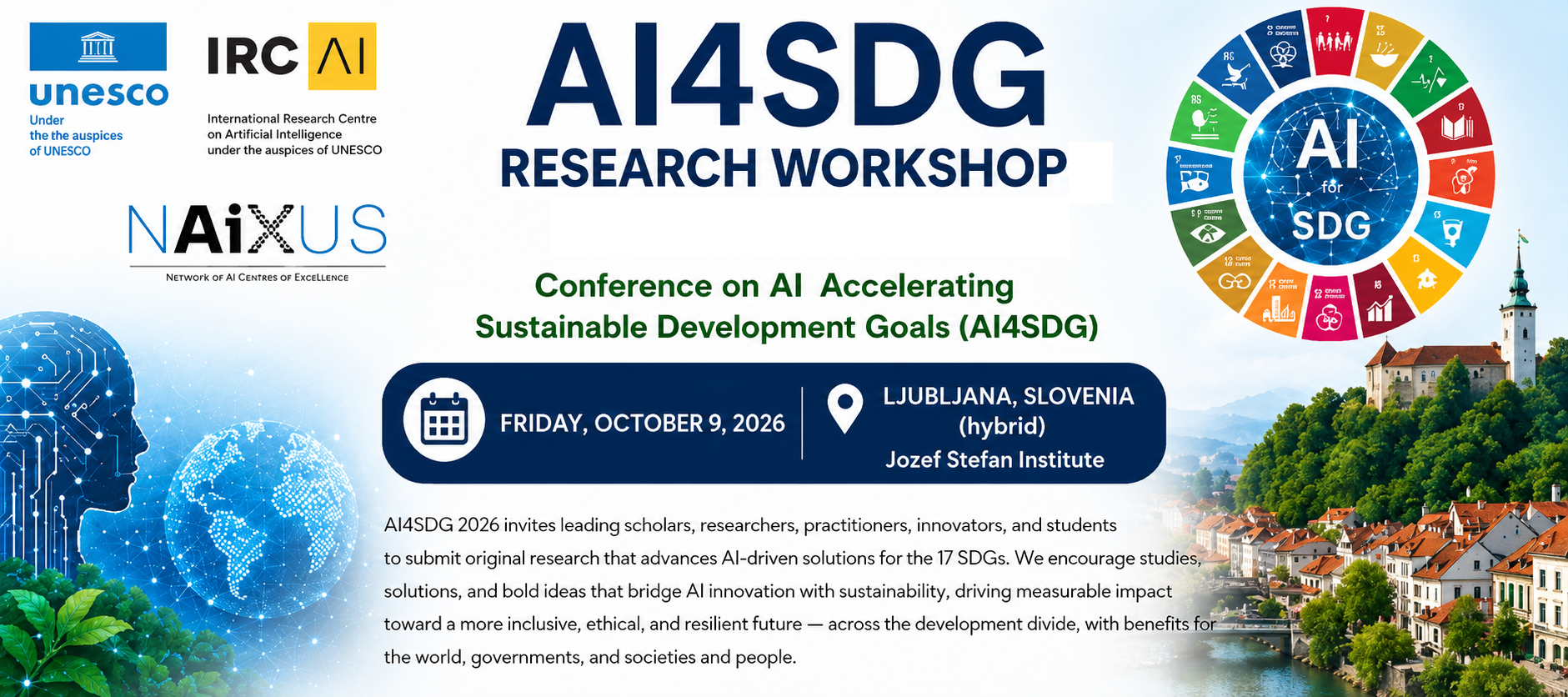
AI4SDG 2026 WORKSHOP
Artificial Intelligence Accelerating Sustainable Development Goals (AI4SDG)
Organized by: Network for Artificial Intelligence, Knowledge and SUStainable development
Date: 9th of October 2026
Location: Ljubljana,Sovenia
Website: https://is.ijs.si/?lang=en
This workshop is colocated with the 29th International Multiconference IS2026 held on October 5-9 2026 in Ljbljana, Slovenia. It is hosted at the Jozef Stefan Institute, in cooperation with IRCAI and CIAAM at the University of Sao Paulo (Brazil).
The “AI Accelerating Sustainable Development Goals (AI4SDG)” workshop, hosted by Naixus, aims to harness Artificial Intelligence (AI) for advancing Sustainable Development Goals (SDGs) with a focus on how AI can support inclusive, ethical, human-centered, and sustainable development across sectors and regions. The workshop seeks the needed discussion of experts and innovators on interdisciplinary research addressing both technological innovation and societal impact, emphasizing practical applications, governance frameworks, policy implications, and responsible deployment of AI for sustainability. This event features a Half-Day Hybrid Workshop, from 9AM to 12PM CEST followed by an online event from 2PM to 4PM CEST. Following the success of past events, such as the AI in Africa & SDGs workshop in Malmo in 2024, it is designed to stimulate discussion, encourage collaboration, and showcase AI solutions, the workshop seeks to connect researchers, practitioners, policymakers, and communities worldwide.
By showcasing impactful AI initiatives and facilitating the exchange of knowledge and experiences, this initiative aims to strengthen collaboration between AI and SDG communities worldwide. It seeks to identify practical approaches for applying AI to climate action and to support progress towards the Sustainable Development Goals through innovative technological solutions. Bringing together participants from diverse backgrounds, the workshop provides a platform for advancing sustainable development by exploring how AI can contribute to addressing global environmental and societal challenges.
| Time | Activity | Details | |
| 09:00 | Welcome | Opening Remarks | John Shawe-Taylor and Joao Pita Costa |
|
09:10 – 09:30 |
Keynote | Mapping Artificial Intelligence Research for Climate Change Resilience, Disaster Risk Reduction, and Environmental Sustainability: A Bibliometric Perspective on Accelerating the SDGs | Parvathy S U Amrita Vishwa Vidyapeetham, India |
| 09:30 – 09:40 | Paper Presentation | Beyond AI Governance: Digital Space Resilience and the Bad Actor Problem |
Sebastian Hallensleben, Centre for a Positive Digital Future, Geneva, Italy |
| 09:40 – 09:55 | Paper Presentation | Documented, Not Governed: Public Algorithm Registers and the Runtime Gap in EU AI Act Deployer Obligations |
Zoran Nasteski, QX, Florence, Italy |
| 09:55 – 10:10 | Paper Presentation | ClimateRAG: AI-Assisted Comparative Analysis of National Climate Commitments and Open Corpus | Innocent Nyalala, IIT Madras Zanzibar, Tanzania |
| 10:10 – 10:20 | Paper Presentation | The Emerging AI Power Crisis or Collusion of Two Revolutions | UN University, Portugal |
| 10:20 – 10:30 | Paper Presentation | Sustainable Artificial Intelligence Infrastructure and Digital Sovereignty: Data Centers, International Data Transfers, and Onward Transfers in Brazil | Leonardo David Quintiliano, University of São Paulo, Brazil |
| 10:30 – 10:50 | Coffee Break | ||
| 10:50 – 11:00 | Keynote | AIDE: Leadership in AI Literacy for Inclusive SDG-Aligned Learning in Marginalized Educational Communities | Mohammad Rizal Mohd Yusuf, Julieyana Jaris, Ministry of Education, Malasya |
| 11:00 – 11:10 | Paper Presentation | Revisiting Sustainability by Design in AI Protocol Governance: An Empirical Review of Comparative DAO and Corporate-Led Standards for the SDGs | Luyao Zhang, Duke Kunshan University, China |
| 11:10 – 11:20 | Paper Presentation | Rethinking the ‘Good’ in AI for Good: Communities as Judges of University-Led AI for Sustainable Development | Yang Bong, University of Nottingham, UK |
| 11:20 – 11:30 | Paper Presentation | Decolonising the Digital Classroom: A Theoretical Case for AI-Mediated Indigenous Knowledge Integration in Open Distance eLearning | Terungwa James Age, Univ. of South Africa, SA |
| 11:30 – 11:40 | Paper Presentation | Strengthen educational initiatives and capacity-building activities related to AI and sustainability for consideration | Sneh Bansal, OE4BW & NCERT, India |
| Break | |||
| 14:00 – 14:05 | Welcome | Opening of the Online Session | Essa Mohamedali, Tanzania AI Community Victor |
| 14:05 – 14:20 | Keynote | AI-Based Analysis of Online Data for Climate Hazard Resilience: From Digital Traces to SDG13 Indicators | Nirel Kadzo, CMU Africa |
| 14:20 – 14:30 | Paper Presentation | AI-Enabled Knowledge Infrastructures for Social Innovation: Business Value, Adoption, and Governance | Gabriel Isaac Lacson Ramolete, Aboitiz Data Innovation |
| 14:30 – 14:40 | Paper Presentation | An evaluation study we performed on younger students’ interactions with a learning chatbot that was built by the Ministry of Education, Singapore | Amal Nammouchi, Sabrina Amrouche, AfriClimate AI |
| 14:40 – 14:50 | Paper Presentation | From Documents to Signals: Toward an AI-powered Policy Intelligence Framework for Global AI Governance | Edmond Anthony Ng’walago |
| 14:50 – 15:00 | Paper Presentation | Artificial Intelligence Readiness in Brazilian Schools: A Nationwide Survey of Teachers and Educational Challenges | |
| 15:00 – 15:10 | Paper Presentation | Governing AI in Primary Education: A Process-Aware Policy Framework | |
| 15:10 – 15:20 | Paper Presentation | Equitable Urban Flood Risk Mapping with Ensemble Machine Learning and Google Earth Engine: A Responsible AI Approach for Climate-Resilient Cities in Data-Scarce Regions | |
| 15:20 – 15:30 | Paper Presentation | AI-Enabled Collaborative Urban Design for Sustainable Development: A Machine Learning Approach to Participatory Planning in Isfahan | |
| 15:30 – 15:40 | Paper Presentation | Generative AI Readiness for Future Skills and Lifelong Learning: Perspectives of Engineering and Non-Engineering Students at UTB and Universiti Malaya | |
| 15:40 – 15:50 | Paper Presentation | Privacy-Preserving Federated Causal Inference for Sustainable Smart Cities | |
| 15:50 – 16:00 | Closing Remarks | Reflections and Closing Remarks | Joao Pita Costa & Senja Požar |
Note: Each presentation slot includes a 5-minute Q&A session.

Network administration and website powered by International Research Centre in Artificial Intelligence under the auspices of UNESCO (IRCAI)
Jožef Stefan Institute, Jamova cesta 39, SI-1000 Ljubljana
FOLLOW NAIXUS UPDATES
The designations employed and the presentation of material throughout this website do not imply the expression of any opinion whatsoever on the part of UNESCO concerning the legal status of any country, territory, city or area of its authorities, or concerning the delimitation of its frontiers or boundaries.